I'm sitting in a motel room right now, getting ready to start the long drive home.
I made the 500 mile drive to see my mother, who's in a nursing home. She gets up and around fine, though she moves more slowly than she used to. Her continued mental decline is obvious. She got confused about who I am, and asked, "Are we related somehow?"
The Alzheimer's/Dementia has stolen what was once a sharp brain. Every week, I call her, but she can never remember where I live, what I do, or how far I am. She doesn't have any clue where she is.
It's so sad to see. She had her own house, with a large walk-in closet overflowing with clothes -- she enjoyed shopping, my mother. I had more clothes when she was around, because I'd end up buying something when I'd take her to the mall. I never go there now.
She's in what could be a hospital double-room, with a roommate. It's been made to be as pleasant as possible. She has virtually no personal belongings, and all her clothes fit into a little 30-inch wide closet.
She used to cut and perm her hair herself. She took a lot of pride in her appearance, and was always nicely dressed and groomed, even if she was home alone.
Now, her hair is longer than she would ever have let it get, unkempt, unpermed, and it could have used a washing.
The nursing home staff seems pretty decent, though. The place is clean, neat and smell-free. As a Eucharistic lay minister/visitor, I've been in some that are dogs.
Speaking of dogs, Betsy came with me. She enjoyed getting to go with me, and she kept me company on the drive. I'm staying in a pet-accessible motel.
Betsy got a lot of attention at the nursing home. The residents and and even staff enjoyed petting her. I used to take Betsy to one of the local nursing homes that had a pet-therapy program, but we haven't done that in a long time.
Mom fed Betsy part of lunch, and the rest of it stayed on the tray, uneaten. I brought Mom a tin of butter cookies, which she loves, along with some other gifts. She had eaten a few of those, before lunch. She still has little appetite.
Mom wanted me to spend the night there, in her "spare" bed (her roommate's).
May God have mercy on us all.
Saturday, September 30, 2006


Tuesday, September 26, 2006
A change of name
I'm hereby giving notice of my change of name: I shall henceforth be known as "Saint Pat."
I've been thinking about this a while. I'm cranky, sarcastic and not always easy to get along with. Neither was St. Paul. Or St. Peter.
The "Saints" of church history are hardly any nobler. They're often misogynistic (St. Thomas Aquinas), bullying (just about all of them), nut jobs (St. Francis and his St. Clare - two of my favs, but today, they'd both be heavily medicated), and out of touch (all the mystics, including another of my favs, Julian of Norwich).
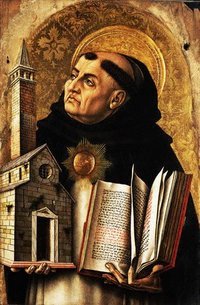 St. Thomas: just another frat boy
 Many led less than church-sanctioned lives before having religious conversions (St. Augustine), and even after.
Like them, though, I'm passionate about the God who came down from heaven for a walkabout on the planet Earth, in the form of Jesus Christ. My failings don't dim my devotion.
Therefore, I shall claim my title as saint, knowing my place in the Kingdom of God, where I will walk in the Garden and sit at the feet of my master, waits for me.
 St. Julian will be my example. I will strive to have her vision, her sweetness of nature, and her understanding.
While I make no claim to sainthood, I am Saint Pat.
Sunday, September 24, 2006
Makes a lot of sense, doesn't it?
Sometimes it strikes me anew how fascist an attempt at coup the Network/AAC is perpetrating. No wonder its leaders are aligning themselves with people like Peter Akinola of Nigeria. They think on the same fascist/totalitarian pages.
Now, maybe in Nigeria, the lines of power run straight up and down, and no one would dare contradict the archbishop. What he says goes.
In the United States and many other provinces of the Communion, power is distributed a little more evenly.
We have a presiding bishop, a house of bishops, laity. In each diocese there's a similar structure. After all, we live in a republic, which has always prided itself on due process and the democratic process. Not so, everywhere, of course.
Let's do a little comparison:
For hypotheses' sake, let's say the last two presidential elections were conducted honestly, and there's no question President Bush is entitled to the title of leader of the United States.
Let's say that I am governor of the Great State of Midlandia. I don't like the way things have been going in this country. And besides, I've always cherished the idea I'd be president some day, and I'm really put out that this doesn't seem to be happening. I've had a little grudge thing going for years. It makes me dislike the pres and his predecessors all the more.
I've been forging alliances with leaders of other countries. Ones who are pretty ruthless about getting things done and holding power. Ones whose view of morality I share.
I declare that as the preznit of the U.S. is not a fit leader, and this country is going straight down the tubes, anyway, I don't have to respect the Constitution of the United States or the Constitution of Midlandia. In fact, I'm rewriting Midlandia's constitution to give me the authority to do what I want to do.
I say Midlandia is still a member of the United States of America and I'm still a citizen of the country, with all my rights, even as I go about putting Midlandia under the oversight of the Dictator of New Zeality. So don't think about removing me as governor.
I'm taking the assets and tax monies (local and federal) of the people of Midlandia and putting them into a new entity called the Council of New Zeality in America (CONZA). CONZA, in turn, funnels money to New Zeality, where the dictator has been refusing assistance monies from the USA to feed New Zeality's starving people, on moral principle, calling Americans depraved and not fit to help his people.
Even though I proclaim I can't obey the laws of the U.S. or respect the authority of Congress or the President, I still proclaim I'm a loyal citizen of the U.S. -- while I send delegations to neighboring states to get them to join CONZA and gain support for a plan to overthrow Congress and the President, replacing them with the Dictator of New Zeality, who will appoint me in charge. My henchmen are all assured of positions of power in a new and glorious day.
I'm swearing allegiance to the Dictator of New Zeality for now, because I think he's going to help me become president, down the road. After all, we agree on how countries should be run, and what rights people should and shouldn't be allowed to have.
People aren't able to make the correct choices most of the time, anyway, so they should just accept our choices for them.
We know the tactics of playing on peoples' fears and prejudices to get what we want.
It doesn't seem to occur to me that these agreed-upon tactics can be turned against me.
Friday, September 15, 2006
This explains a lot
After reading Father Jake's doggy post, I remembered this theological debate over cats I read a few years ago.
Jack the Brat says no self-respecting cat would EVER ask for or eat Alpo, while Elvis says, "Well, I wouldn't say never."
From Anglican Media Sydney:
June 20, 2001
The cat sat on the mat...
How would the Church of England deal with the statement that "the cat sat on the mat" if it appeared in the Bible?
The liberal theologians would point out that such a passage did not of course mean that the cat literally sat on the mat. Also, cat and mat had different meanings in those days from today, and anyway the text should be interpreted according to the customs and practices of the period.
This would lead to an immediate backlash from the Evangelicals. They would make it an essential condition of faith that a real physical, living cat, being a domestic pet of the species Felix Domesticus, and having a whiskered head, a furry body, four legs and a tail, did physically place its whole body on a floor covering, designed for that purpose, and which is on the floor but not of the floor. The _expression "on the floor but not of the floor" would be explained in a leaflet.
Meanwhile the Catholics would have developed the Feast of the Sedentation of the Blessed Cat. This would teach that the cat was white, and majestically reclined on a mat of gold thread before its assumption to the Great Cat Basket of Heaven. This is commemorated by singing the 'Magnificat' and 'Felix Namque', lighting three candles and ringing a bell five times.
This would cause a schism with the Orthodox Church, which believes tradition requires Holy Cat's Day (as it is colloquially known), to be marked by lighting SIX candles and ringing the bell FOUR times. This would partly be resolved by the Cuckoo Land declaration recognising the traditional validity of each.
Eventually, the House of Bishops would issue a statement on the doctrine of Feline Sedentation. It would explain, traditionally the text describes a domestic feline quadruped superjacent to an unattached covering on a fundamental surface. For determining its salvific and eschatological significations, we follow the heuristic analytical principles adopted in dealing with the Canine Fenestration Question (how much is that doggie in the window?) and the Affirmative Musaceous paradox (yes, we have no bananas). And so on, for another 210 pages.
The General Synod would then commend this report as helpful resource material for clergy to explain to the man in the pew the difficult doctrine of 'The cat sat on the mat.'
***
Now, go a couple of entries down, and admire the pix of my cats and dog. I'm really wounded that no one's told me how cute and purr-sonality-ful they are. You don't want to make me angry, do you?
Monday, September 11, 2006
Surely they jest
When I first read it, I thought it was a joke gone awry. You know, one of those tongue-in-cheek satirical pieces that got picked up and treated as real. But I keep seeing it, and the Connecticut Six don't seem to have much of a sense of humor.
No, this is really the Network case against Bishop-Elect Katharine Jefferts Schori. It came from the Connecticut Six Web site (www.ctsix.org). The article's called "AN APPEAL TO THE ARCHBISHOP OF CANTERBURY: MUST READ!" by the Bishops of Central Florida, Dallas, Fort Worth, Pittsburgh, San Joaquin, South Carolina, and Springfield (20 July, A.D. 2006)
The bishops believe, "There are effectively two churches under one roof. The common roof is called the (Protestant) Episcopal Church in the United States of America."
No joke. Things they indict Schori with are the things for which I admire her!
You can read the whole schlmiel over there, but here's the Schori indictment:
APPENDIX C
Concerns about the Presiding Bishop-elect
1. We are concerned that the Presiding Bishop-elect embodies the majority's disregard of the
Windsor Report:
• She voted for the consent to V. Gene Robinson
• She permits rites of blessing of same-sex unions
• She has sharply criticized the Windsor Report's "ignorance" of ECUSA
• She has indicated that she will continue on the current path
• She has called the status of resolution B033 into question
2. We are concerned that the Presiding Bishop-elect does not represent our views to the
Communion:
• She has a disregard for the views of the Instruments of Unity or Communion
• She has been sharply critical of members of the Primates' Meeting
• She does not share a clear commitment to the Archbishop's vision of a Covenant
• She has inadequate regard to the consequences of "walking apart"
3. We are concerned that the Presiding Bishop-elect holds theological views that are at
variance with the historic tradition:
• A problematic view of Jesus
• A confused message on the place of Jesus in the Church
• A partial understanding of the Reign of God (Kingdom of God)
• An exclusively social justice view of the mission of the Church
4. We are concerned that the Presiding Bishop-elect has indicated a hostile attitude toward the
minority's faith and witness:
• She attributes their opposition to the prevailing direction as of "the Evil One"
• She has indicated a confrontational stance with respect to these bishops
Citations:
1. Disregard of the Windsor Report:
On consent to the bishop of New Hampshire
"I participated in the vote to consent to his election. ... I believe that the people of New
Hampshire have the right to choose the person they believe is best suited to their particular
ministry needs. I recognize that this election will cause deep grief and pain to a number of
people in this church, and I deeply lament that reality." (Pastoral Letter, Aug 2003)
On blessing same-sex unions
"The nature of blessing a relationship, whether a marriage or a same-sex partnership,
means that the community who stand with the couple also promise to bless them." (2003
Diocesan Convention Address)
"THEREFORE, BE IT RESOLVED: That the 33rd Annual Convention of the Episcopal
Diocese of Nevada, desiring to support relationships of mutuality and fidelity which mediate
the grace of God between those persons for whom the celebration and blessing of a marriage
is not available, does hereby recognize that ceremonies to celebrate the relationships of such
persons who are baptized members in good standing in this diocese may be conducted by
clergy in the diocese, with the approval of the bishop, respecting their pastoral discretion."
(Resolution adopted by Diocese of Nevada, 2003)
"I said that a parish wishing to do so would have to get the congregation to agree, to show that
it was not an isolated event, divorced from the rest of its activities. The couple would also
have to receive counselling, like anyone getting married." (The Guardian, Jun 2006)
On the Windsor Report
"The Windsor Report contains some significant misunderstandings and errors of fact. It does
not clearly recognize how the polity of the Episcopal Church varies from that of most other
parts of the Communion" (Speech in Seattle, Nov 2005)
On the present course
"I am fully committed to the full inclusion of gay and lesbian Christians in the church."
(Episcopal News Service, Jun 2006)
On B033
Concerning the possibility of consents for a partnered gay/lesbian candidate for the
episcopate:
"[Louie Crew:] 'You don't get much of a choice if a diocese elects a lesbian or gay
bishop.'
"[Jefferts Schori:] 'That's right, and if God brings us to that day, I think we will act according
to how the Spirit moves us. I am sorry not to be able to be more direct.'" (The Witness
Magazine, Apr 2006)
In the House of Bishops, she said, "This resolution will have to be reviewed very soon."
2. Concerning the Communion:
On the Instruments of Unity
"I don't think Jesus is as interested in instruments of unity as he is in whether or not we're
serving his brothers and sisters or feeding the hungry. The Episcopal Church and the Anglican
Communion are going to survive if we manage to work together at healing the world."
(Address, Church Divinity School of the Pacific, Nov 2005)
On ECUSA being, as one reporter put it, "thrown out of the Communion"
"It will be unfortunate if we don't have partners, but the reality is lived at the level of local
relationships, at local levels: folks from Nevada going out and helping in Kenya."
(The Guardian, Jun 2006)
On the Anglican Communion
In an interview: “ … the Anglican Communion is a gift to be cherished, and a gift that needs
to be increasingly valued and appropriated through our own sacrifice, albeit not at the cost of
what this church believes to be faithful response to the gospel." (The Living Church, 2006)
On what she will say to Peter Akinola
"I will ask him what encourages him to see some of God's children as less than human and
less worthy of the dignity that our liturgy believes is the right of all human beings."
(The Guardian, Jun 2006)
On the decisions of General Convention on sexuality
Interview: "[But] these decisions were made because we believe that's where the Gospel has
been calling us. The Episcopal Church in the U.S. has come to a reasonable conclusion and
consensus that gay and lesbian Christians are full members of this church and that our
ministry to and with gay and lesbian Christians should be part of the fullness of our life."
(Time Magazine, Jul 2006)
On the Covenant idea
"[The Archbishop of Canterbury is] very clear that we're not going to see an instant solution.
He's also clear about his role: it is to call people to conversation, not to intervene in diocesan
or provincial life—which some people have been asking for." (Time Magazine, Jul 2006)
On the Windsor Report
"All of this is a very long way of saying that neither this [Lambeth] commission, nor the
Archbishop of Canterbury, nor the gathering of primates, can make rules or laws that bind the
Episcopal Church." (2004 Diocesan Convention Address)
3. Theological Views:
On Jesus
"We who practice the Christian tradition understand him as our vehicle to the divine. But
for us to assume that God could not act in other ways is, I think, to put God in an awfully
small box." (Time Magazine, Jul 2006)
On the message of Jesus
"The Bible tells us about how to treat other human beings, and that's certainly the great
message of Jesus - to include the unincluded." (CNN, Jun 2006)
On her reference to "Mother Jesus" in her sermon after election
"Our mother Jesus gives birth to a new creation - and you and I are His children."
(Episcopal News Service, Jun 19, 2006)
"It was very deliberate and conscious. I was wrestling with the image of blood on the cross,
the image of labour. It's medieval imagery actually, Julian of Norwich. It seemed appropriate
to the text and the hard work we are trying to do in this place." (The Guardian, Jun 2006; NB:
she did not cite the reference of any sort to this phrase in her sermon.)
On the Reign of God
Integrity (reporter): "Can you tell me about the reign of God?"
Schori: "I think of the scripture from Isaiah read by Jesus in the synagogue, the blind see,
the lame are healed. ... Our vision is one of social justice like the vision enshrined in the
Millennium Goals. The Millennium Goals are our vision of the reign of God." (ENS News
Conference, Jun 18, 2006)
On Revelation
We believe that revelation continues, that God continues to be active in creation, and that all
of the many ways of knowing — including geology, evolutionary biology, philosophy, and
arts such as opera, punk rock or painting — can be vehicles through which God and human
beings partner in continuing creation.
On the place of doctrine
"[Q] 'What is your prayer for the church today?' [A] 'That we remember the centrality of our
mission is to love each other. That means caring for our neighbors. And it does not mean
bickering about fine points of doctrine.'" (Time Magazine, Jul 2006)
On doing theology
"Our heritage and context shape our theology. The ways in which we understand scripture and
appropriate gospel response to social realities are shaped both by our roots and our current
circumstances." (Speech in Seattle, Nov 2005)
On making faith decisions
"Making any kind of faith decision is based on accumulating the best evidence one can find -
what one's senses and reason indicate, what the rest of the community has believed over time,
and what the community judges most accurate today." (The Witness Magazine, Aug 2005)
4. Hostile attitude toward the minority:
On characterizing the minority
"I think it is the Evil One who is at work here, distracting us from our central focus, which
ought to be on feeding the hungry, relieving the needs of the poor, healing the sick. This
obsession is keeping us from doing that. To focus on issues of sexuality when people are
dying is a distraction from our mission."
On the minority in the House of Bishops, called 'dissenters'
"I think they need to be challenged, more so than they have been. I see signs of hope in
the House of Bishops, an unwillingness to continue to put up with bad behavior. We
haven't seen any action yet, but I think it is coming." (The Witness Magazine, Apr 2006)
When asked if that would be a 'verbal rebuke'
"It won't be enough in some cases, I am sure. But I have the sense that there is some desire to
hold each other accountable for actions that are not canonical, for actions that have the
appearance of being downright schismatic." (The Witness Magazine, Apr 2006)
Sunday, September 10, 2006
Pat's Animal House
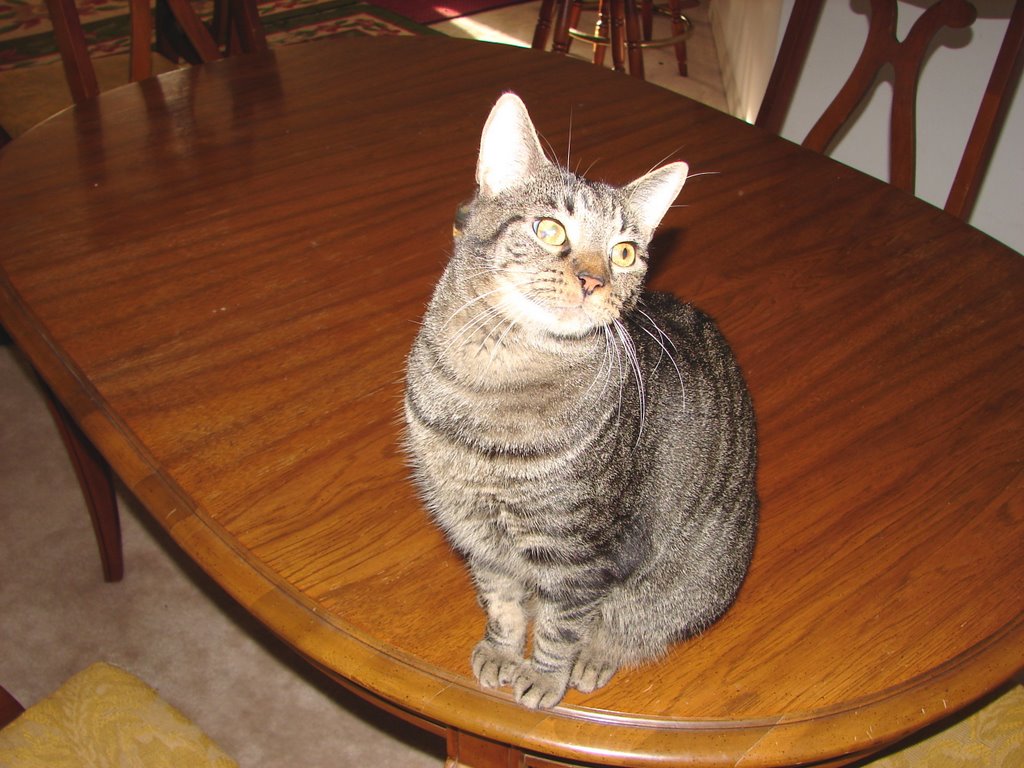
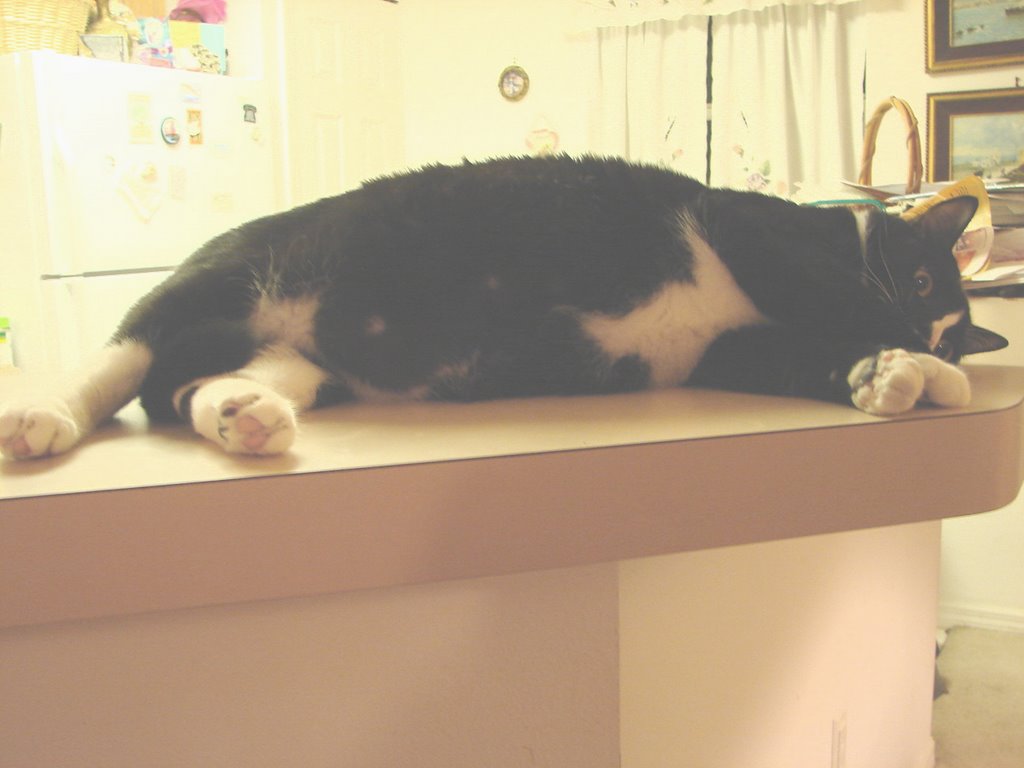
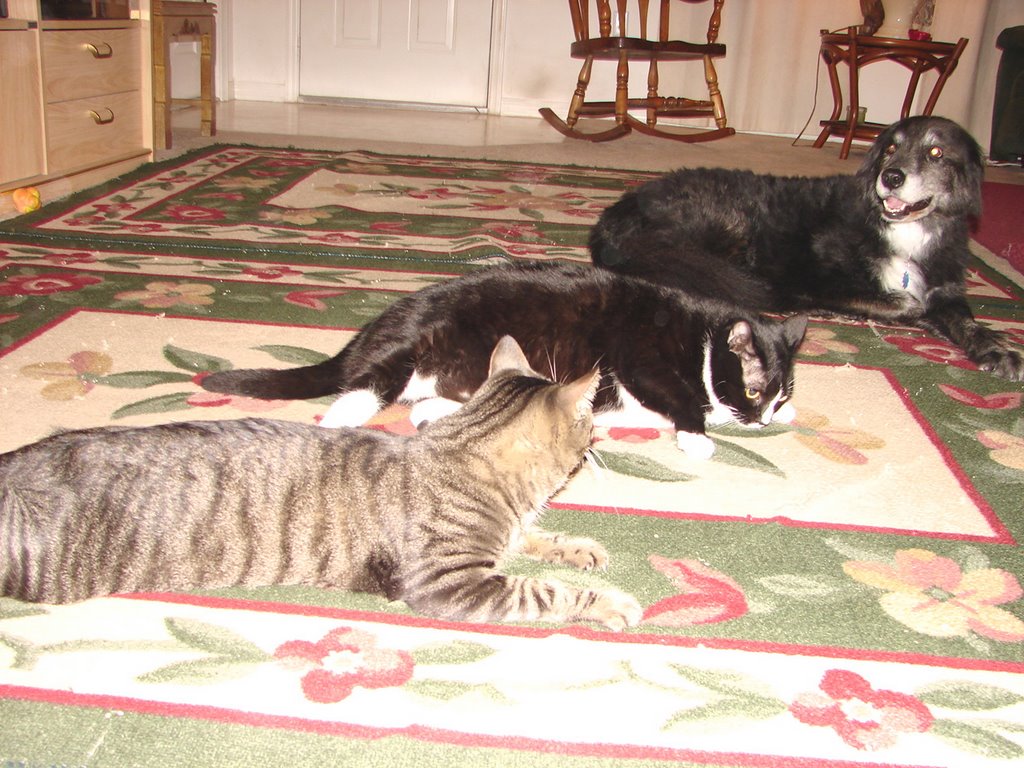
Every picture tells a story. I certainly see the three very different personalities of my three animals. There's Elvis, who spends most of his time stretched out on his side (you would, too, if you had to carry that belly around). There's Jack, nimble and quick, and not camera shy in the least. There's Betsy, whom the camera makes nervous, but who's patient and loving and the best dog in the whole world.
Elvis: cat or Orca? You be the judge.

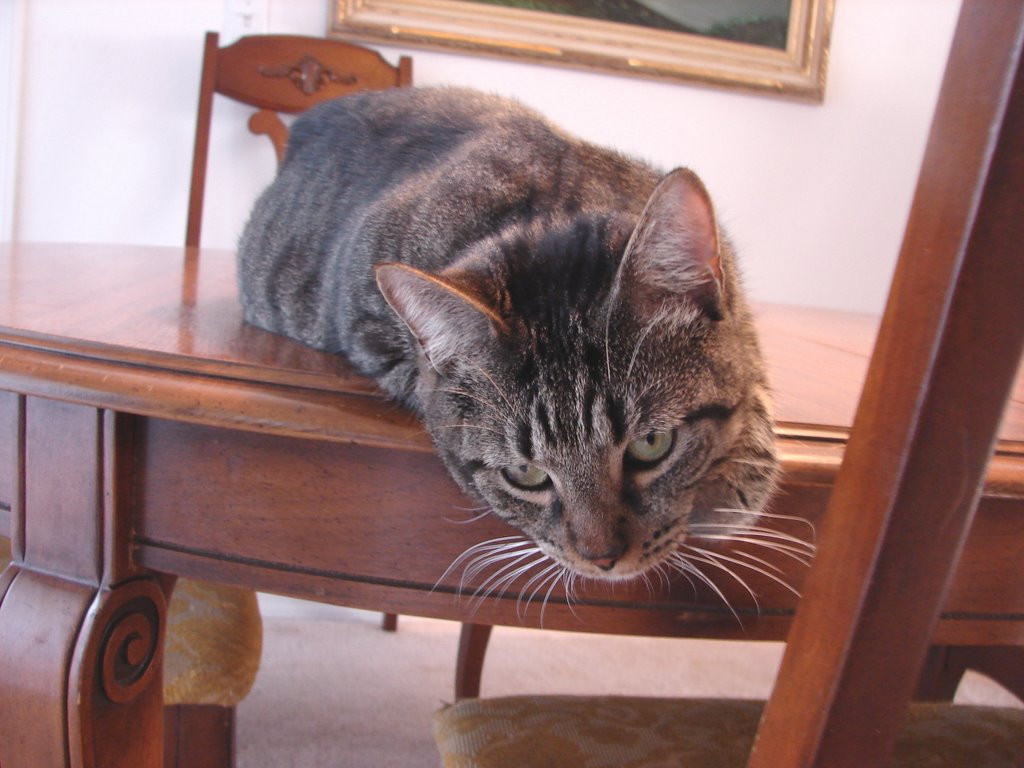

TIGER, tiger, burning bright
In the forests of the night,
What immortal hand or eye
Could frame thy fearful symmetry?

I don't know if I like what's going on here.


Simply the bestus dog that ever was


Orca, er, Elvis, gets the last word.
Saturday, September 09, 2006
Toewalker's back
Our friend Jeffrey, aka Toewalker, took a hiatus after the Archbishop of Canterbury said some particularly cloddish things. He's back, now, thanks to his true grit and the prayers of his friends.
Go take a look at this posting by his partner, R. at Musings of a Toe-walker. It's a gutsy and illuminating piece.
I marvel at the strength and courage of some of the saints.
P.S. I can't make the link work. Just go look at "A Boy and His Church."
Thursday, September 07, 2006

Pirates of the Anglican Communion:
Dead Man's Province, Part Cinq

Note: To read Part 1, go here. For Part 2, go here; For Part 3, go here. To read part 4 ... oh for Heaven's sake, just look back a couple of entries. Criminy. I haven't blogged that much lately.
Sparrow wakes up. His skull feels like his brains will simply pound through it. The floor beneath him is a bit uneven. It's cold, hard and dank.
With a moan, Sparrow pulls himself to a sitting position. His sword is missing, but quick checks reveal his flask, cross and Holy Water are intact in secret pockets sewn into his clothing. Sparrow takes a quick swig from the flask to ease the pain in his head, and becomes a bit more aware of his surroundings.
He's in a cell. A torch on the wall outside the cell provides its only light. Sparrow sees Father Jake in the shadows, and shakes him. Jake comes to, moaning as Sparrow did just moments before. Jake refuses Sparrow's offer of the flask, and pulls himself to a sitting position.
"Where are we?" Jake asks.
"I don't know. I only just came to, myself," Sparrow responds.
They hear slight sounds coming from the wall to the left of the cell door.
Jake puts his ear to the wall, listening. His fingers touch the bricks of the wall like those of a blind man reading Braille. He works out an uncemented brick, and the sounds of soft crying come through the opening.
"Who's there?" Jake asks.
The crying stops for a moment. A small voice says, "It's me. The Pirate Robert Duncan."
Peter Lorre plays the Pirate Robert Duncan

"Duncan?" Jake says. "What are you doing in a cell, here?"
"They took it away. All of it. My lovely church buildings, the pension funds, the tithes. They said they owned everything now, and didn't need me. When I told them they couldn't do that, they threw me in this horrible cell."
He starts crying again.
"Duncan, what is this place?"
"We're in the prison, on the lower level of the castle keep."
Duncan puts a rheumy eye to the rectangular opening.
"On the upper level is where the Gospel's being held prisoner," he says.
"The Gospel held prisoner? That's ridiculous. What are you talking about?" Jake replies.
"The Gospel. Pope Akinola has it encased in amber. He said, this way he knows nothing can ever change. The longer the Gospel stays trapped there, the greater the darkness grows. The farther back we go in time."
Duncan is silent for a moment, then his eye, opened wide, appears at the aperture again.
"Are you here to save the Gospel? To save us all? A prophet told me God will let the Gospel remain there, unless enough people want to save it."
Frowning, Jake asks, "Duncan, where are your pirate cohorts?"
"I don't know. They just disappeared."
Sparrow hears footsteps coming toward their cell. He motions to Jake, who replaces the brick.
The two men hear the sound of metal on metal as a key is inserted in the lock, and the cell door swings open.
"Here, you," a big thug says to Sparrow, and the thugs drag him off, his feet kicking at the floor in protest, and in a vain effort to get his footing.
A half hour later, Sparrow is the one crying.
Sparrow: swashbuckling no more

The big thug looks at him impassively. The smaller one cackles.
"Where is the Schori woman?" he asks.
"I don't know," Sparrow replies honestly, but he summonses as much defiance as he can into his answer.
He realizes his captors don't know where the bishop is, if they're trying to torture the information out of him.
"No one has endured the wheel more than 30 minutes without his head exploding," the short troll chortles, turning the lever, and the platform bearing Sparrow, tied to a chair, glides on wheels into a soundproofed room.
The voice in a video narrating the wonders of the Convocation for Anglicans in North America (CANA) drones on again.
"NOOOO!" Sparrow cries. "MOMMYYYYYYY!"
He feels warmth coming from the pocket holding the cross his mother gave him when Sparrow was just a young lad. The cross she gave him just before she died.
*****
Meanwhile, somewhere past the mists of Province X, somewhere where the sun shines, MadPriest has been fulfilling his mission. People are gathering -- Episcopalian, Anglican, Lutheran, Methodist, Congregationalist -- even a few Nazarenes cautiously come out to join the chorus of voices. Pope Benedict prohibits Catholics from joining the ecumenical gathering, but millions, worldwide, ignore this just as they do most papal edicts, and join in.
People clasp hands and sing, "I'd Like to Teach the World to Sing." They drop to their knees together, and pray for the Gospel light to be set free.
Even the Amish join in. At Archbishop Desmond Tutu's urging, people all over Africa (except most of them in Nigeria and Rwanda, of course) pour into the streets, singing and praying.
The Dalai Lama chants prayers for his Christian friends, odd though they are.
What is the meaning of this? Where is Bishop Schori?
Stay tuned to find out.
Wednesday, August 23, 2006
The hired hand
I've written about this before. This passage and its meanings have been on my mind quite a bit, lately.
The Gospel of John 10:1-8 describes the true shepherd versus the hired man. Jesus is the good shepherd who loves and protects his sheep.
"I have come so that they may have life and have it to the full. I am the good shepherd: the good shepherd lays down his life for his sheep. The hired man, since he is not the shepherd and the sheep do not belong to him, abandons the sheep as soon as he sees a wolf coming, and runs away, and then the wolf attacks and scatters the sheep; he runs away because he is only a hired man and has no concern for the sheep."
The metaphor of the shepherd is perhaps the most meaningful one in the Bible, and perhaps the most beautiful in all literature. The shepherd is the one who guides and protects, who literally lays himself down at the sheep gate to protect his flock from nighttime predators.
 The good shepherd is the one who clears rocks to provide a green meadow full of life sustaining food for his flock. The good shepherd is the one who cleanses harmful parasites from his sheep, literally anointing their heads with oil.
 The good shepherd is the one who speaks to his sheep, and sings to them, so they recognize his voice out of all the other voices, and follow him to safety.
The good shepherd is the one who does not leave even the least one behind, but carries him close to his heart.
I love my Shepherd.
Contrast this image of the shepherd to the hired hand, the one to whom sheep are sheep. They're not too smart, but they're a source of income. The hired hand counts them as nothing compared to his own needs and wants.
The role of the bishop is modeled on the role of the good shepherd.
The good shepherd does not trust a man with his flock because the man says the things the shepherd wants to hear, or because the man promises the shepherd a good job working for the hired man's boss. The good shepherd doesn't turn his flock over to anyone who would treat his sheep carelessly, or abandon in the wilderness any of the sheep the hired hand perceives to have a blemish.

Angry sheep
I'm just a sheep, but I know who cares and who doesn't care about me. I don't want a hired hand looking after me.
Most of the time, I'm a nice little sheep. But don't try herding me into any foreign corral, where the hired hands won't take care of me, and might even kick me.
I'm just a sheep, but I can scream loudly, and I have teeth. I'll chew through the rope holding the corral gate shut.
Tuesday, August 15, 2006
Pirates of the Anglican Communion:
Dead Man's Province, Part Quatre

Note: To read Part 1, go here. For Part 2, go here; For Part 3, go here.
After traveling through a dry, barren wasteland for many hours, the Band of the Three-Legged Stool slows as its members approach a river.
Bishop Schori holds up her hand in the universal sign for "stop." On foot, she, Father Jake and Sparrow cautiously approach a rough, wooden bridge spanning the river. It's old, and worn, and bleached white with age. Beneath it, sluggish black water oozes past.
The smell wafting up from the water is rank. It tells a tale of dead things, of decay, of lost hope.
Schori turns to Jake and Sparrow and asks, "Will this bridge carry our weight?"
The two men gingerly step on the first plank. It creaks, but holds.
"Perhaps we should cross it one rider and one horse at a time," Sparrow says.
They stand staring into the sludgy water. The smoky mist rising from it seems to fill the land on the far bank.
Jake understands why MadPriest looked so drawn. As the band drew deeper into the wasteland, an oppression settled over him like a shroud. He felt it pushing him down, as if into the earth itself. The pinched expressions around him tell him others are suffering from it, too.
Jake shakes his head, trying to jar loose the sense of doom.
Schori looks at him with concern.
"We must pray before we take another step," she says.
Schori calls the entire band together. They stand hand in hand, or hand on shoulder, head bowed, as she prays, "Dear mother God, look after us as a hen looks after her chicks. Shield us from danger under your wing. Bless us that we may accomplish your will here, in this strange land. Bless us that we may then return home safely."
She anoints each rider and each horse, and pronounces individual benedictions. Then she approaches the convoy of vehicles.
"I don't think your trucks and vans will make it across this bridge. I don't know what we'll find on the other side. What say you; do you wish to turn back?"
"We stand together," Jeffrey says. "We will not turn back."
"Lisa the Crucifer will hold high the cross. It will be as a beacon for us," he adds.
Lisa, dressed in white, steps forward with determination, holding the cross before her. Its golden light radiates around her.

"Very well," Schori says. "Onward. I'll go first. If it's safe, you, Jake, then Sparrow, then Lisa, then the rest of the horse riders, then those on foot. Remember, one at a time."
Sparrow says, "No, milady. My charge is to protect you, and bring you safely to Lambeth Palace. I cannot let you perish here, in this unholy water." He looks down at it with disgust. "I will go first, and make sure the bridge can be safely passed."
After a bit of arguing and a coin toss with Jake to settle the argument of who will go first, Sparrow proceeds.
Cautiously, he steps onto the bridge, holding his horse's reins. The horse follows hesitantly, with a little nicker of anxiety.
The bridge creaks ominously. The horse's eyes roll with fright, white showing all around.
Sparrow takes another couple of steps. One board breaks, but he and the horse scramble past it. They make it to the misty land on the other side.
The horse's flanks continue to tremble in fear.
Sparrow removes a coil of rope from his saddlebag.
"Jake," he calls. "Catch this. Wrap the middle of it 'round Bishop Schori, and hold fast your end, until she's safe across the river."
"Aye," says Jake. He carefully girdles Schori with the rope, then cinches the end of the rope's length around the saddle horn on his horse, for good measure.
Everyone holds their breath until Schori arrives safely on the other side. Sparrow and Jake hold the rope so tightly, her feet barely touched the planks as she crosses.
Schori loosens the rope around her and wheezes in a gulp of air.
Her horse, like Sparrow's, quivers in fear.
Jake ties the rope around Lisa, then, holding her elbow, he escorts her across the bridge. His horse follows closely behind him.
Another plank breaks, and the horse slides toward the edge, scrambling for footing. Jake pulls on the reins with all his strength, and the horse stops. The animal then follows Jake so closely his nose stays under Jake's arm, as they complete their tortuous journey.
One-by-one, the remainder of the band cross the bridge.

"It's only your prayers got us all here safe," Sparrow says, bowing to the bishop, who bows back to him.
He hears a cracking of twigs in the woods lining the road. Sparrow draws his sword as he turns toward the sound, but it's too late. A horde of screaming Fundamentalists attack the band, beating them with Bibles.
Sparrow senses danger, draws his sword, but it's too late.

Sparrow sees Jake, Schori, Jeffrey, and the rest valiantly trying to repel the blows, but in this place, they're vastly outnumbered. Growly screams, quoting Leviticus and Deuteronomy, are almost as terrorizing as the two-handed swings with heavy Bibles.
Under the hail of thumps to his head, Sparrow falls to the ground, unconscious.
What will happen to our intrepid band? Will it survive this attack?
Be sure to tune in for the next episode of Pirates of the Anglican Communion.
Monday, August 14, 2006
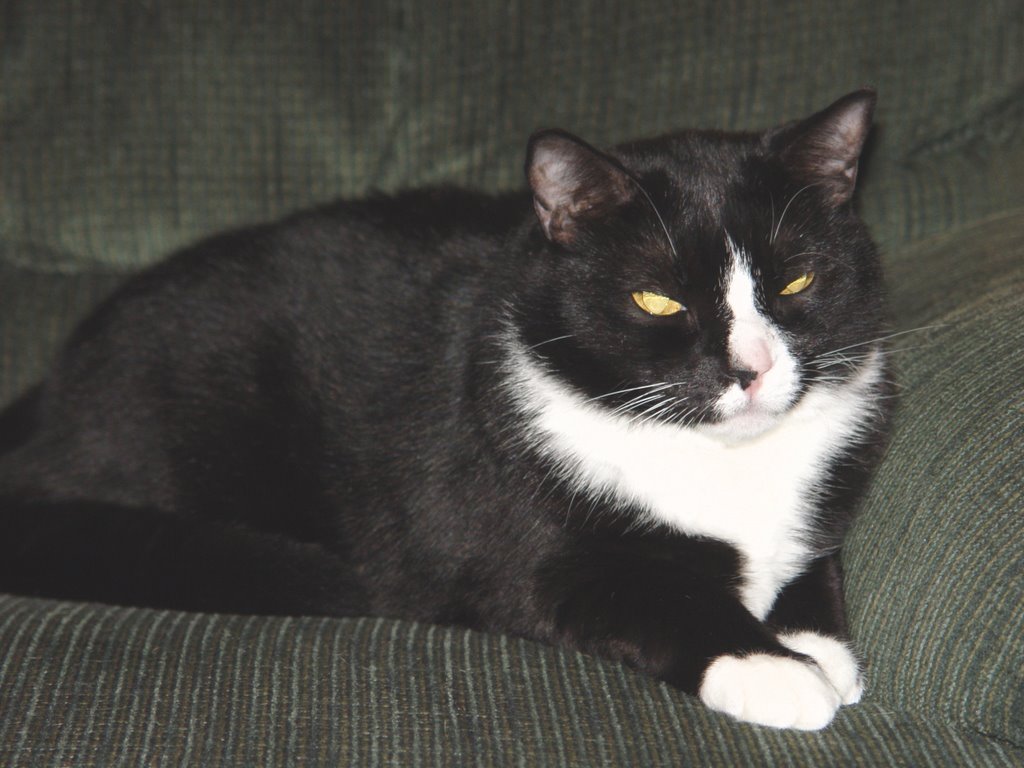
Elvis Rex: There oughta be a law
Note from UnSaintly Pat:
I was going to write my Sunday-evening installment of Pirates of the Anglican Communion, but went fishing instead. Elvis took a turn at the blog while I was gone.
Elvis speaks:
I'm looking for a lawyer. I want to sue, and I'm thinking there's maybe a class-action suit in this for a good lawyer.
It all started last week, when the UnSaintly One went to see an allergy doctor. After a bunch of testing, the verdict came in. The UnSaintly One's allergic to two things, he told her: dust .... and CATS.
Now, I've been thinking about this all week. I'm convinced this is a lie -- more cat defamation. Cats get blamed for everything. Did the dog get blamed for any allergy? No.
Is it ever the dog? No. Did the doctor tell her to keep Betsy, the dog, off the bed? No.
Who's sleeping on the bed now? The dog.
Even the UnSaintly One says, "Betsy's the good girl."
But Jack and I, we're the "bad boys." Just because the furniture gets clawed up -- and that's Jack, not me. So we jump around in the kitchen while she's trying to cook, and knock things off the counter. Knock things off her desk. Chew up and tear up a few things. Yak on the carpet. Pull down the sheers from the window. Big deal.
I don't see why the UnSaintly One minds me drinking from her glass. It's a cat thing.
Let's face it. We live in an anti-cat culture. Think of all the Disney movies. The cat is always the bad guy. Remember the cat in Cinderella? Portrayed as evil, trying to harm those poor little mice. Mice aren't so cute in real life, though I hear they're pretty tasty.
And remember the sicko Siamese in Lady and the Tramp? The list goes on. Just about every animated Disney movie has a cat villain.
The anti-cat movement goes back to the Middle Ages, when we were blamed for the plague.
So, I want a lawyer to go after not just the doctor, who suggested the UnSaintly One should make us yard cats (thank God she didn't), but let's go after the studios, books and magazines, too, on behalf of all cats, everywhere.
Wednesday, August 09, 2006
Welcome to the neighborhood
We welcome Toewalker at Musings of a Toe-Walker and Lisa at My Manner of Life to this neck of the blogosphere neighborhood.
These Missouri thorns in the right-wing side bring their lives, perspectives and dry wit with 'em.
We in the UnSaintly household particularly enjoyed this image:

You wouldn't expect a furor over something like this, but the Network Purity Police, Midwestern Division, jumped all over Lisa for posting it, accusing her of making racial slurs. Get a life, people.
The truth is, they were looking for something to complain about, without revealing their own prejudices. Thus, revealing their own prejudices.
You've got to admit, the term "Anglican Primates" does create a mental image of our closest relations (now I'll get hate mail from the Creationists) jumping around in robes and mitres!
Lisa and Toewalker have much more than this to say, both humorously and seriously. Check them out.
Sunday, August 06, 2006

Pirates of the Anglican Communion:
Dead Man's Province, Part Trois
Note: To read Part 1, go here. For Part 2, go here.
MadPriest
rides his horse all the way up to the command post before dismounting. He's immediately beset with questions. Brushing the queries aside, he grabs the coffeepot, fills a mug, and downs it.
"You need everything you've got to keep you going out here," he says.
"Sit down and rest for a moment. Are you all right?" Schori asks.
"Yes. I'm exhausted. It's that place," MadPriest replies. "It's oppressive. With each mile into that Godforsaken land, the air became heavier. Stifling."
"What about the horses? Where's your Geo Tracker?" Father Jake queries.
"I had to abandon the Geo Tracker about five miles in. It just quit. No modern invention works there. Even my watch quit, a bit after the Geo sputtered out. Then the watch started running backwards," MadPriest says, holding his watch up for them to see.

The watch hands jumped erratically, forward and back.
"I think it's trying to right itself now," MadPriest explains.
"Were you able to determine where Province X is? And where we are?" Father Jake asks.
"Maps are useless there. I think it's somewhere in Texas." MadPriest rubs his face. "Although, there were some indicators of Nigeria. It's all very confusing. Where we are now? Just in a wasteland, on the edge of Province X."
"Listen," MadPriest continues. "Most of the people there are confused. They don't know where they are. And it's growing darker and more oppressive by the hour. The people are frightened, and they don't know what to do. They don't know which direction will take them out."
"How did you find your way out?" Father Jakes asks.
"It was the oddest little fellow. He's some sort of mystic. He found me wandering, and told me, 'Madly Priest. This way is no good you go. Go you must back to the real world, and tell them, you will. This: pray you must, if you want the Gospel light. If to pray no one cares enough, then God will not work to perpetuate the lightness. Tell them, pray they must, to free the Gospel light.'"
MadPriest went on, "The gnomish bloke said there's a castle in the heart of Province X. There, the Gospel light is imprisoned. There, also, is the source of a spreading darkness. We must set free the Gospel light, but it will be impossible, without worldwide prayer in support. He gave me the horses, and pointed the way out. He said to find you and tell you."
"How did he know about us?" Father Jake asks.
"I don't know," MadPriest says. "He just seems to know everything."
The three brood for a bit. Finally, Schori says, "Then, that's what we must do. MadPriest, take the truck and go back. Get everyone to pray. Tell them they must believe, and pray."

Schori turns to Jake. "You and I will lead in as many as we can get on horseback. We're going in. We have to."
Jake bows. "I am at your service, Madam."

Soon, a line of riders on horseback threads across the wasteland. Behind follow vehicles, whose drivers refused to turn back. They pledge to follow on foot when their vehicles quit.

Stay tuned for more adventures of the Band of the Three-Legged Stool.
Tuesday, August 01, 2006
Abandonment of the communion of the Episcopal Church
Here's the article about Bp. John-David Schofield.
I wonder if Pittsburgh's Bob Duncan can't be far behind. In his July 31 speech at a Network meeting, he denounced the discipline of the Episcopal Church, said he's been in communication with other primates (Global South, I would presume) about establishing a mission district here -- with or without the Archbishop of Canterbury. Duncan will also pull the Network and any dioceses he can into an alternate Communion, without the ABC. See the text of Duncan's speech here
From Episcopal News Service:
Committee set to review accusation against San Joaquin bishop
By Mary Frances Schjonberg
Monday, July 31, 2006
[Episcopal News Service] The Episcopal Church's Title IV Review Committee is preparing to deal with accusations that Diocese of San Joaquin Bishop John-David Schofield has abandoned the communion of the Episcopal Church.
Bishops J. Jon Bruno of Los Angeles, Jerry M. Lamb of Northern California, James R. Mathes of San Diego and then-diocesan William E. Swing of California sent the letter to Bishop Dorsey Henderson of Upper South Carolina in mid-July. The letter cites Canon 9 of Title IV of the church's canons, entitled "Of Abandonment of the Communion of This Church by a Bishop."
Henderson, the senior bishop among the members of the 2007-2009 Review Committee, said July 31 he was not comfortable releasing the substance of the letter.
"There is a provision that is pretty clear dealing with the other kinds of misconduct that says that all of the matters related to a presentment will be confidential. That provision does not appear in Canon 9, but I am not sure whether that is oversight or intentional—but I feel that, unless the whole committee makes a decision otherwise, this ought to be confidential as well, unless I have the release–and I will ask them—of Bishop Schofield and the others," Henderson said.
Various websites and blogs had been speculating in recent days about such an investigation and what it might entail, up to and including a presentment and ecclesiastical trial.
"It is not a presentment," Henderson said. "It is not dealt with in the same sense that other misconduct would be dealt with."
It has been reported elsewhere that the bishops claimed evidence of abandonment in San Joaquin's action at its last diocesan convention, when it changed its constitution to qualify its agreement to submit to the Episcopal Church's Constitution and Canons. Article V, Section 1, of the Constitution says that a diocese's constitution must accede to that of the Episcopal Church.
At its last convention, the diocese changed its constitution to read that the diocese would accede "to the extent that such terms and provisions, and any amendments thereto, adopted by the authority of the General Convention, are not inconsistent with the terms and provisions of the Constitution and Canons of the Diocese of San Joaquin..."
Henderson said that the members of the 2003-2006 Review Committee have unfinished business from the just completed triennium and thus Bishop Charles Keyser is still chairing the committee. Henderson said he and Keyser have agreed to have the two committees meet at the same time and in the same place, as soon as the former committee receives a report of an investigation initiated as a result of a previously filed allegation. That allegation has nothing to do with Schofield, Henderson said.
A news release on San Joaquin's website says that "the [diocese's] Chancellors have already responded to the initial allegations by challenging the appropriateness of the specific Canon Law [IV.9] being used to bring charges."
"In short, these allegations are neither relevant nor justified," the short statement concludes.
Henderson said he has received a letter from the San Joaquin chancellor and has replied indicating that the 2006-2009 committee would meet for organizational purposes in August or September, and that he told Swing the same thing.
Title IV, Canon 9 says that a bishop abandons the communion of the Episcopal Church if he or she takes one of the following actions:
* open renunciation of the Doctrine, Discipline, or Worship of the Church;
* formal admission into any religious body not in communion with the
same; or
* exercising episcopal acts [Holy Orders and Confirmation] in and for a religious body other than the Episcopal Church or another Church in communion with the Church ...without the express consent and commission of the proper authority in the Church.
Read the full text of Title IV Canon 9.
Other canons in Title IV deal with other misconduct on the part of bishops, such as crime, immorality, holding or teaching doctrine contrary to that of the Church, violating the rubrics of the Book of Common Prayer, violating the constitution and canons of the Episcopal Church or of a bishop's diocese and violating one's ordination vows.
If the committee determines by a majority vote that Schofield has, in fact, abandoned the Communion of the Church under the terms of Canon 9, it must certify its decision to the Presiding Bishop. If the three senior bishops having jurisdiction consent, the Presiding Bishop must then inhibit Schofield "until such time as the House of Bishops shall investigate the matter and act," according to the canon.
During that time, Schofield could not exercise any episcopal, ministerial or canonical acts except those related to the "administration of the temporal affairs" of his diocese.
The three senior bishops are Leo Frade of Southeast Florida, Peter Lee of Virginia and Don Wimberly of Texas.
Schofield would have two months from the time he receives notice of the committee's certification and the inhibition to declare in a "verified written statement" that the facts alleged in the committee's certification. If he does not make such a declaration, the canon says, he will be liable to deposition, or removal from office.
If Schofield did supply the statement and the Presiding Bishop believed it to be a "good faith retraction of the declarations or act relied upon in the certification" or a "good faith denial" that the bishop made the declarations or committed the acts, the inhibition could be ended by the Presiding Bishop, with the three senior bishops' consent.
Otherwise, the Presiding Bishop must present the matter to the House of Bishops at its next regular or special meeting. If a majority of the bishops entitled to vote gives its consent, the Presiding Bishop must depose the bishop.
The appointments to the 2007-2009 Title IV Review Committee were Suffragan Bishop Bavi E. Rivera of Olympia, Suffragan Bishop David C. Jones of Virginia, Bishop C. Wallis Ohl Jr. of Northwest Texas, the Rev. Carolyn Kuhr of Montana, the Very Rev. Scott Kirby of Eau Claire, J.P. Causey Jr. of Virginia and Deborah J. Stokes of Southern Ohio. Causey, Kirby, Kuhr and Stokes served on the 2003-2006 Review Committee.
-- The Rev. Mary Frances Schjonberg is national correspondent for the Episcopal News Service.
Monday, July 31, 2006
An Inconvenient Truth
I saw Al Gore's movie a couple of weeks ago, and I've been thinking about it a lot.
Many Central Floridians, along with all South Floridians and untold numbers around the world, can say their prayers, then kiss their patooties goodbye, if Al Gore is right. And experts say he is.
Between rising sea levels because of polar ice melting and more Category 5 hurricanes, there won’t be much left of the Florida Peninsula.
The cause is global warming, and we have about 10 years to turn the tide. Maybe.
Global warming is caused by the greenhouse effect — all the carbon dioxide released into the atmosphere by burning petroleum and coal products to run our power and manufacturing plants, vehicles and homes.
Carbon dioxide stays in the atmosphere. Heat generated from the sun’s rays warming the Earth’s water and land can’t escape back into space, because it’s trapped by this layer of gas.
With the world population growing exponentially, expected to increase 42 percent from 2003 to 2050 — from 6.4 billion to 9.1 billion — and with Third World countries becoming greater consumers of power, there’s no way power consumption will go down.
The temperature of Earth and its oceans spirals upward. Sea levels rise. The snows of Mount Kilimanjaro and the ice of the Himalayas melt. Lakes and glaciers disappear.
Chunks of ice floating down from the North Pole actually cool waters where the Gulf Stream meets the North Atlantic waters, disrupting the return flow of the Gulf Stream, with disastrous results. Subtropical waters grow warmer, fueling more and more powerful hurricanes: more Katrinas.
In May, National Geographic News took a look at the former vice president’s predictions, with a view to debunking errors, but didn’t find them. See the article online at http://news.nationalgeographic.com/news/2006/05/060524-global-warming.html.
Instead, scientists confirmed hurricanes and typhoons have become more powerful over the past 30 years — since greenhouse emissions started spiking.
Heat waves will become more frequent, and more deadly. National Geographic reported, “2005 was the hottest year on Earth since the late 19th century, when scientists began collecting temperature data. The past decade featured five of the warmest years ever recorded, with the second hottest year being 1998.”
Deaths from global warming will double in 25 years, to 300,000 a year, extrapolating from the heat wave that racked Europe in 2003.
It’s one thing to make predictions about what could happen in the future; it’s another to endure the consequences, and the movie shows them. We’re living with the results of our actions.
Some areas flood because of melting mountain ice; others turn into dust bowls because of changed weather patterns and water flow. Category 5 hurricanes become routine.
The question is, can we overcome our dependence on big oil companies and others who profit from the current system and who put out disinformation about global warming?
Gore quoted Upton Sinclair, who said “It’s hard to get a man to understand something when his salary depends upon his not understanding.”
Maybe when most Americans wake up and realize the lives of their children depend on it, they’ll understand. They'll start demanding solar energy and other clean fuels we've had the technology for, but haven't done anything about. We've been passive and apathetic. We've let big oil interests and their cronies continue to rake in billions, while the Earth suffers.
We’d all better understand, and make noise, before it's too late.
Go see the movie.
Friday, July 28, 2006
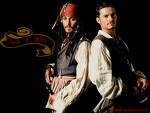
Pirates of the Anglican Communion:
Dead Man's Province, Part Deux

Sparrow and the band of hundreds of clerics and determined lay people amass on the journey to the border of Province X. Though it is only early afternoon, darkness and uneasiness descend swiftly upon them.
The band of the Three-Legged Stool traveled across featureless plains all day. Vehicles began to act erratically around noontime. Some trucks stalled, and refused to start again, and those vehicles were abandoned, of necessity.
Sparrow is at a loss to explain the deepening darkness.
 The sun should be bright in the sky, yet it looks like a winter's evening.
Sparrow, Schori and Father Jake agree to halt and make camp until MadPriest (Orlando Bloom) returns from a scouting expedition.

The aroma of coffee fills the air as the command team pores over maps, trying to determine exactly where they are in this featureless land, and where the border to Province X lies, for no one knows exactly where the tenth province begins. They speculate about the causes of the enveloping gloom.
Sparrow surreptitiously pulls a flask from his pocket and pours "a little" rum into his coffee.
 "Arrggghh. I remember a day like this only once before. It was 20 years ago, and we were chasing the ghost ship into deep waters of the Atlantic. There was monstrous evil things out there..." Sparrow stops to finish his cup.
The air is still and silent. There's no trace of life around them — neither the chirp of a single bird nor the yip of a lone coyote.
Suddenly, the air is filled with thundering hooves.
 It is MadPriest on horseback, and 50 more horses follow, tethered to a line trailing from his saddle.
What happened to MadPriest's Geo Tracker? Where did he find the horses?
Only readers of the next installment will know.
Wednesday, July 26, 2006
Two bishops, two letters
Two different retired bishops, writing two very different letters about the Diocese of Central Florida and the request for alternative oversight.
What do you think?
Letter No. 1
Below is the text of a letter published in this week's issue of The Living Church.
P. 15
Actions Unnecessary
I have read the decision made by the bishop, members of the standing committee and exective board of the Diocese of Central Florida to request alternative primatial oversight. In doing this they have joined the five other dioceses that have made this request of the Archbishop of Canterbury. I don't know what procedures the other dioceses followed to reach their decisions. I do know that Central Florida's decision was not reached by any broader constituency than the entities mentioned above.
As this is the diocese I served as bishop for the 20 years from 1970 until my retirement in 1990, I wish to go on record as disapproving of the decision, not only of Central Florida, but any diocese that follows this procedure. I have written to the Bishop of Central Florida to register my disappointment, disapproval, and dissociation from the decision.
I believe these actions are unnecessary, premature and inappropriate. I cannot believe they will do anything to strengthen the mission and ministry of Jesus in our world. I believe we can rely on Jesus to keep his promise to send the Holy Spirit tolead us into all truth.
The Rt. Rev. William H. Folwell
Bishop of Central Florida, retired
Letter No. 2
This is an open letter from retired bishop Ben Benitez of Texas to retired bishop Walter Righter of Iowa, concerning Bishop Righter's public criticism of Central Florida's request for AlPO:
July 22, 2006
AN OPEN LETTER TO +WALTER RIGHTER:
Walter, back off in your castigation of the Diocese of Central Florida.
In the first place, they have not said that they are leaving the Episcopal Church. They are merely seeking the ministry of an alternate Primate to that of one who at GC 2003 voted for the Consent to the Consecration of Gene Robinson, - to that of one who has authorized the Blessing of Same Sex Unions in her diocese, - and to one who prays at public services to "Jesus, our mother"!
Walter, you must know that ever since you and your cohort, Jack Spong, took to, knowingly, ordaining non celibate homosexual persons, that many people in this Church, like those who comprise the Diocese of Central Florida, and
many others of us, regard you and those who have done as you do as apostate, as having abandoned some of the fundamental faith and practice of the One, Holy Catholic and Apostolic Church. You have departed from the teaching of
the Church that has been upheld for 2,000 years, and what is more, probably 95% of Christians in the world, including an overwhelming majority of the members of the Anglican Communion, also regard you as having done so.
Furthermore, this is not only a matter of sexual behavior, but an even more important matter is that so many priests and bishops, in your theological camp, no longer believe that Jesus is still the Way, and the Truth, and the Life. Many deny the heart of the evangelical faith, that salvation, and the hope of the world, and our hope for Eternal life, is found in the Cross, and Resurrection of Jesus Christ.
Why you even voted at GC 2003, along with the rest of the liberal revisionist bishops, NOT to reaffirm your commitment to the Chicago Lambeth Quadrilateral, with its strong affirmationof the authority of Holy Scripture as the Word of God. In doing so, you voted against "the Faith once delivered to the Saints", and in fact you repudiated your own Ordination vows!
Walter, in your lecturing to the Diocese of Central Florida, you spoke of reconciliation. However, in GC 2003 when you and others in the leadership of TEC forged ahead with a vote for the Consecration of Gene Robinson, you
were utterly defying the rest of the Anglican Communion, who were pleading forTEC to hold off until there was at least a shred of consensus in the Communion for your action. Where then was your appeal for reconciliation? And yet you, Walter, speak about Central Florida engaging in "coercion"!
And after we of TEC have all but torn this Communion apart, and now in 2006, with the rest of the Communion having given us two years to respond to the Windsor Report, our response was all but a sham, with our squeaking and our quibbling not remotely in compliance with Windsor? What sort of act of reconciliation do you call that?
Walter, I fully respect your right, and that of the rest of the bishops and deputies to disagree on any matter with the rest of the Communion, but why not do so honorably, and without a pretense of compliance? Why not clearly declare that TEC is unwilling to pay the price set forth in the Windsor Report by the rest of the Communion, for us to remain in the Communion, and that therefore, we are choosing to walk our separate way, and that we wish the rest of the Communion well.
Finally, Walter, you allege that Central Florida has said to the rest of the Church, " It is my way or the highway!" And you are wrong, for the living truth is that it is TEC that has said just that, both in GC 6003 and GC 6006, and it is the rest of the Anglican Communion that has been told by us, "You accept our way, or you take the highway!"
+Ben Benitez
Thursday, July 13, 2006
Playing now in a diocese near you: 
Pirates of the Anglican Communion:
Capt. Jack Sparrow (Johnny Depp) finds himself drawn into a supernatural battle, when the Archbishop of Canterbury (Robbie Coltrane) charges him with bringing Katharine Jefferts Schori, Presiding Bishop of the Episcopal Church (Keira Knightley), safely to a meeting at Lambeth Palace.
Sparrow arrives in the U.S. only to find the pirate Robert Duncan (Peter Lorre) and his cohorts have raided and looted six dioceses, and taken their people as slaves into a land they have stolen from others and renamed Province X. They declare themselves its rulers. Little do they know the true plans of Akinola of Africa (Darth Vader), with whom they have forged a compact.
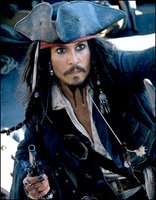
Schori tells Sparrow he must rescue the stolen dioceses before she will acompany him to England. What is Sparrow to do?
He knows entering Province X may doom him to eternal Inquisition, endless fundamentalism and intolerable Calvinism. Yet, in order to break the compact, restore life to the Anglican Communion and save the exiles, he must go in.
 Schori pledges to stand with Sparrow, as does Father Jake
(Johnny Depp. Or maybe it really is Father Jake.)
Together, they rally the forces of True Anglicanism, the Via Media and the Free Dioceses, under the banner of the Three-Legged Stool.
Sparrow remembers the vials of anti-viper venom and Holy Water the Archbishop gave him (as well as the cross his mother gave him, but which he usually keeps hidden), and holds them closely. Bishop Schori arms herself with the Sword of Truth and holds high the Bible. Father Jake arms himself with the Preparation of the Gospel of Peace and the Shield of Salvation offered to all. They see others around them similarly armed.
What will be their fate? What adventures and misadventures lie before them?
[Ed. Note: these events are fictional, so far.]

Pirates of the Anglican Communion:
Dead Man's Province
Capt. Jack Sparrow (Johnny Depp) finds himself drawn into a supernatural battle, when the Archbishop of Canterbury (Robbie Coltrane)
 charges him with bringing Katharine Jefferts Schori, Presiding Bishop of the Episcopal Church (Keira Knightley), safely to a meeting at Lambeth Palace.
Sparrow arrives in the U.S. only to find the pirate Robert Duncan (Peter Lorre) and his cohorts have raided and looted six dioceses, and taken their people as slaves into a land they have stolen from others and renamed Province X. They declare themselves its rulers. Little do they know the true plans of Akinola of Africa (Darth Vader), with whom they have forged a compact.
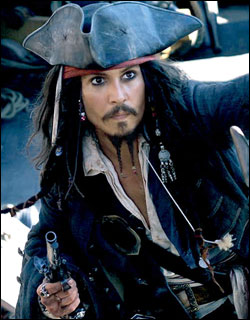
Schori tells Sparrow he must rescue the stolen dioceses before she will acompany him to England. What is Sparrow to do?
He knows entering Province X may doom him to eternal Inquisition, endless fundamentalism and intolerable Calvinism. Yet, in order to break the compact, restore life to the Anglican Communion and save the exiles, he must go in.
 Schori pledges to stand with Sparrow, as does Father Jake
 (Johnny Depp. Or maybe it really is Father Jake.)
Together, they rally the forces of True Anglicanism, the Via Media and the Free Dioceses, under the banner of the Three-Legged Stool.
Sparrow remembers the vials of anti-viper venom and Holy Water the Archbishop gave him (as well as the cross his mother gave him, but which he usually keeps hidden), and holds them closely. Bishop Schori arms herself with the Sword of Truth and holds high the Bible. Father Jake arms himself with the Preparation of the Gospel of Peace and the Shield of Salvation offered to all. They see others around them similarly armed.
What will be their fate? What adventures and misadventures lie before them?
[Ed. Note: these events are fictional, so far.]
Tuesday, July 11, 2006
News from Central Florida, TEC and the Communion
Central Florida:
There's good news. Here in Central Florida, 32 clergy members signed a statement yesterday, rejecting schismatic actions in this diocese. More were expected to sign today, but I haven't seen a tally yet.
The first portion comes from purpose section of the Constitution of the Diocese of Central Florida, and the second portion rejects the recent actions:
"We, the Clergy of the Episcopal Church in Central Florida, acknowledge our allegiance due to the One, Holy, Catholic and Apostolic Church of Christ and recognize the body known as the Protestant Episcopal Church in the United States of America otherwise known as the Episcopal Church to be a true branch of said Church, having rightful jurisdiction in all its dioceses, and hereby declare our adhesion to the same and accede to its Constitution and Canons. We do not accede to any action or effort on the part of Central Florida's diocesan leadership or convention which seeks to disassociate us from the Episcopal Church, the actions and authority of General Convention, or the Anglican Communion."
Pittsburgh:
[Ed. Note: bolding within the text of this document is mine.]
NINE PARISHES CHALLENGE RECENT ACTIONS
OF THE BISHOP AND STANDING COMMITTEE
OF THE DIOCESE OF PITTSBURGH;
DECLARE THEIR LOYALTY TO THE EPISCOPAL CHURCH
Pittsburgh, PA, 11 July 2006.
Nine urban, suburban and rural congregations in the Episcopal Diocese of Pittsburgh today challenged the recent actions of the Right Reverend Robert William Duncan and the Standing Committee of the Diocese of Pittsburgh. On 28 June 2006, the Bishop and Standing Committee announced their intention to withdraw from the duly recognized, geographically-determined Province III of The Episcopal Church, envisioning the emergence of a theologically-determined "Province X." The parishes believe that these steps, if left unchallenged, could effectively remove the Diocese from The Episcopal Church. The congregations further believe that by requesting "alternative primatial oversight," the Bishop and Standing Committee seek to remove the Diocese from the oversight of the presiding bishop elect of The Episcopal Church, the Right Reverend Katharine Jefferts Schori. The parishes also believe that all of these actions constitute an effort to retain use of property which is properly within the jurisdiction of The Episcopal Church while withdrawing from The Episcopal Church.
History and Rationale
The Episcopal Diocese of Pittsburgh is a founding member of the Network of Anglican Communion Dioceses and Parishes, and the Right Reverend Robert William Duncan, bishop of Pittsburgh, serves as its moderator. The Network was formed following the election of the Right Reverend V. Gene Robinson as bishop of New Hampshire in 2003. Subsequent to this development, the Diocese of Pittsburgh, at its conventions of 2003 and 2004, passed an amendment to the Constitution of the Diocese of Pittsburgh, declaring that the Diocese would not be bound by decisions of General Convention when such decisions ran counter to its own understanding of Faith and Order. In the Stipulation which ended the lawsuit filed in the Allegheny County Court of Common Pleas by Calvary Church, Pittsburgh, and St. Stephen's Church, Wilkinsburg against Bishop Duncan et al., all parties agreed that congregations in the Diocese desirous of disaffiliation from the Network could achieve that end by notifying the Bishop in writing. We believe that in their act of disaffiliation from the Network, those congregations expressed their loyalty to The Episcopal Church.
Representatives from eleven congregations that have opted out of the Network held a meeting on 29 June 2006. In subsequent meetings the following statement was drafted, and was subsequently accepted by representatives of the parishes indicated below. It is offered as a manifestation of our faithful understanding of Christ's love, and is predicated on a belief that the way to resolve differences is to seek reconciliation with those with whom we disagree, and not to withdraw from communion with them. It emerges, too, from our belief that The Episcopal Church is part of Christ's one, holy, catholic and apostolic church, and is a church grounded in the Biblical principle of justice.
I. We believe that the action by the Right Reverend Robert William Duncan, Bishop of the Episcopal Diocese of Pittsburgh, and the Standing Committee of the Diocese, announcing their decision to withdraw from Province III is tantamount to leaving The Episcopal Church. According to the Canons of The Episcopal Church, each diocese belongs to one of the nine recognized geographically constituted provinces. While there is a provision for leaving one (geographical) province and joining another, there is no provision for constituting a province based on ideological or theological grounds. We believe that the proposed formation of a Province X, therefore, is canonically and constitutionally irregular, and it is highly unlikely that the General Convention will approve such a province, either in advance of its purported formation, or ex post facto. We believe that since Province X does not exist and is unlikely to exist, leaving Province III constitutes leaving the organized structure of The Episcopal Church.
II. The creation of Province X, in our view, is a mechanism to isolate dioceses, parishes, and perhaps individuals from The Episcopal Church. The formation of the Province is seen by us as the most recent step in an attempt to create a church separate from The Episcopal Church. Since the Diocese is part of The Episcopal Church, and cannot exist apart from The Episcopal Church, we believe that the Bishop and Standing Committee cannot legally remove the Diocese from The Episcopal Church for the purpose of planting it in some other province, or for any other purpose.
III. We believe the request made by the Bishop and Standing Committee for "alternative primatial oversight" is further indication of an intention to depart from The Episcopal Church. Although the Archbishop of Canterbury (at the request of the Primates) did set up a Panel of Reference which could hear appeals from dioceses in dispute with their own national church authorities and "to assist in the resolution of these difficulties" [Panel of Reference Mandate, 6 May 2005] the specific remedy requested is unprecedented and contrary to the basic understanding of the Anglican Communion as a fellowship of autonomous provinces. We believe the request for alternative primatial oversight constitutes a rejection of the duly elected leadership and governing structures of The Episcopal Church.
IV. The Bishop and Standing Committee have cited, in justification for their actions, comments made by the Most Reverend Rowan Williams, Archbishop of Canterbury, in his "Reflections" promulgated in the week following the General Convention of The Episcopal Church. But it must be pointed out that as the Archbishop himself has stated, the Archbishop's statement is not definitive, and nothing in that document is binding. Any final disposition on any restructuring of the Anglican Communion, after consultation with the Primates, the Anglican Consultative Council and other bodies, will, according to the Archbishop, be a lengthy process, a process that will begin in earnest at the Lambeth Conference of 2008. Moreover, even if the Anglican Communion is restructured, that action, in and of itself, would have no effect on the structure of The Episcopal Church, or on the relations between The Episcopal Church and its dioceses. We believe the actions of the Bishop and Standing Committee have interpreted the Archbishop's document to suit their own views. As Presiding Bishop Frank Griswold has said in response to the Archbishop's statement, "It is misleading that some, in responding to the Archbishop's lengthy theological reflection, have focused their attention on speculations about a yet-to-be determined outcome."
V. We oppose any efforts on the part of the Bishop and Standing Committee to take the Diocese outside of the recognized structure of The Episcopal Church. The Bishop and Standing Committee have stated that they believe it necessary for the Diocese of Pittsburgh to "dissociate itself from the actions of General Convention." Since the General Convention is the supreme governing authority of The Episcopal Church, and all dioceses are bound by its actions, such dissociation as described by the Bishop and Standing Committee constitutes, in our opinion, withdrawal from The Episcopal Church. We believe that any resolutions or constitutional amendments passed at conventions of the Diocese of Pittsburgh which would purport to release the Diocese from compliance with decisions of the General Convention are canonically improper and invalid.
VI. According to canon law, property owned by a diocese is held in trust for The Episcopal Church. We believe that the repeated claims of the Bishop and Standing Committee to be the Episcopal Diocese of Pittsburgh, while at the same time acting to separate the Diocese from the decisions of The Episcopal Church, therefore, constitute an attempt to retain legal possession of property held in trust for The Episcopal Church, while at the same time taking steps to remove the Diocese from The Episcopal Church. In light of these actions, we believe that the Bishop and Standing Committee do not represent the interests of the duly recognized Diocese of Pittsburgh.
VII. The authority in The Episcopal Church of any bishop and standing committee of a diocese derives from the authority of the Constitution and Canons of The Episcopal Church, which are set by the General Convention. We believe, therefore, that any claim of the Bishop and Standing Committee that their authority derives from being "in full and unimpaired communion with the See of Canterbury and those churches, dioceses and provinces that uphold and propagate the historic Anglican Faith and Order" is based on specious reasoning.
VIII. In light of the foregoing statements, we further believe that we represent those in this Diocese who are loyal to The Episcopal Church. Accordingly, we extend an invitation to others who wish to remain in The Episcopal Church to join us in our efforts. We remain committed to the building up of the Body of Christ in the Episcopal Diocese of Pittsburgh.
All Souls Church, North Versailles
Calvary Church, Shadyside
Church of the Holy Cross, Homewood
Church of the Redeemer, Squirrel Hill
St. Brendan's Church, Franklin Park
St. Matthew's Church, Homestead
St. Stephen's Church, Wilkinsburg
St. Thomas, Church, Canonsburg
St. Thomas & St. Luke's Church, Patton
Maybe the term "interesting" fits the latest news from Canterbury:
Stephen Bates at UK's The Guardian wrote the oddest story about the Archbishop of Canterbury in the most recent of his pieces about the Anglican Communion. It won't let me post a link to the article -- to see the full text, paste in http://commentisfree.guardian.co.uk/stephen_bates/2006/07/the_bongo_archbishop.html, or google "Stephen Bates" + Going Around in Circles.
The last two paragraphs read:
When I saw the Archbishop of Canterbury on Sunday, he asked me how I thought Saturday's debate had gone. He nodded in agreement when I said that it seemed all the arguments had been made before. I wish he would take a leaf out of the Archbishop of York's book and tell what he described as his "currently confused and struggling church" a little more bluntly how he feels.
I asked him how he felt and he replied sadly: "You don't want to know." Actually, I did. But deep gloom seems to be surrounding the senior staff that the covenant plan to save the Anglican communion is falling apart even before anyone's started discussing what might be in it. One senior figure admitted he did not think the communion could survive until the next scheduled meeting of all the world's Anglican bishops in 2008. Katharine Jefferts Schori has been invited for an early meeting at Lambeth Palace within the next few weeks. They hope to integrate her more closely into the network of Anglican church leaders but this seems a vain prospect given that so many parts of the church's world still don't accept the idea of women in leadership, any more than gays.
Mention the name of Nigeria's conservative (and outspoken) Archbishop Peter Akinola and a strange convulsive, wringing, motion comes over Rowan Williams's hands. If only he would...if only he dared.
If only he would actually take a stand...
A hat tip to the Episcopal Voices moderator for all three of these items of timely interest.
Saturday, July 08, 2006
He just doesn't seem to get it
From President George Bush's press conference during a visit to Chicago July 7, from the L.A. Times:
Answering a question about his authority to try detainees before military tribunals, Bush reiterated his belief that the Geneva Convention does not apply to detainees being held at Guantanamo Bay, Cuba.
"The Geneva Conventions were set up to deal with armies of nation-states," he said. "You've got standard rules of war. So, this is new ground. This is different than any president has been through before, in terms of how to deal with these kind of people that you're picking up off a battlefield and trying to protect the American people from."
Is the president as obtuse as he appears to be? I saw this exchange on the televised press conference yesterday, and couldn't believe that no one challenged it. So, I will.
Mr. President, the Geneva Convention has nothing to do with the character or intent of the prisoner. Absolutely nothing.
Rather, the Geneva Convention lays out how we, as civilized people will treat people who are at our mercy. It's about standards of conduct we set for ourselves, as honorable people. It's about us.
I realize concepts such as "honor" and "mercy" have declined in popularity in recent years. But it not ok to detain people illegally, without representation, then put them in front of military tribunals (who are controlled by you, when it comes down to it). It's not ok to torture, degrade, humiliate or otherwise mistreat prisoners. We are not that sort of people.
At least, we used not to be.
We gained goodwill from former combatants after World War II because we treated prisoners humanely. What will be the legacy of our actions under this administration?
Friday, July 07, 2006
Yearning and learning to love and be loved
The endless debate in the church over sexuality is wearing me out. I'm tired of it.
Leave the analysis to the sciences. It's not necessary to our faith to have a perfect understanding of why people are straight, gay, bi or whatever. It's enough to know that each of us is created uniquely, handcrafted by God.
Like any handcrafted items, no two of us are exactly alike. That's enough to know. God doesn't mean us all to be exactly alike, otherwise, He/She wouldn't have created so much diversity of life on this planet, never mind what else is out there.
That doesn't mean that some of us are more equal than others in God's eye. Unfortunately, we human beings are pretty quick to sort out who's more different than the rest of the (ruling) lot, and treat them as factory rejects.
While there's been a boatload of talk about sexuality, I haven't been hearing much about morality.
Let's spend more time considering how we treat each other, for that defines our morality.
People who go through relationships like potato chips are immoral. They're using and hurting other people, treating them as disposable objects, denying them the reflected light of God we are supposed to be to each other. Bi, straight, gay, whatever, it doesn't matter.
If we sit drawn up in our own meanness and tell others they can't have love because of who they are, we're immoral. We're denying God's children the light of God's love.
Our work as Christians is to shine God's love on each other, and on those who haven't yet come to see that love, so they might see. We can't live without love. The less of it we're exposed to, the less value we see in ourselves and each other.
God's love heals us and brings us to wholeness. It's offered to us directly from God and through each other.
If I see a straight or same-sex couple in a loving, faithful, nurturing relationship, then I must accept this comes from God.
If I see a straight or same-sex couple in an abusive relationship, or where one or both partners are indulging in outside sexual relationships, then something is wrong. Healing is needed, and perhaps the partner who is being exploited and misused may have to leave that relationship to get into the light of God.
To go through a string of such relationships is immoral. It's turning away from the love God wants us to accept.
This is why telling someone he or she is unloveable is such a sin. Heard often enough, the lie is believed, and its impossible to have a healthy relationship when we believe neither God nor anyone else could really love us. That's a tragedy. How awful to tell people they can't have relationships, then accuse them because they don't have it.
Unless we've been unbearably broken somewhere along the line, we all want to be in a loving relationship with another person. It's something I most earnestly desire for myself, and I know it will be a gift from God.
Who am I to deny it to someone else?
It is a sin the church's time and energy have been diverted from doing God's work to the topic of sexuality. I want to hear less about sexuality and more about God.
Tuesday, July 04, 2006
A cause for good cheer
If your spirits need a lift during this time of contention, accusation and separation, watch this.
If we were Roman Catholic, I'd be talking about canonizing Desmond Tutu.
Watch the tape. You'll see Christ shining out of his eyes, and through his being.
Happy Independence Day to everyone, everywhere. Remember we were created as children of God, with the right to enjoy life, liberty and the pursuit of happiness.
Want to see a real firecracker? I got to see the Space Shuttle Discovery streak across the Central Florida skies this afternoon.

Cheers! And God, please give them a safe mission.
Just a suggestion ...
The Episcopal Voices of Central Florida, of which I'm a member, is drafting a response to Bishop Howe's request for AlPO. We will dissociate ourselves from this action, as we should.
The (ultra-conservative, fundamentalist) leadership of this diocese has insulated itself from the people in the pews. There was no attempt to get a consensus from members of the diocese before hooking us up to the Network a couple of years ago. No one even knew the boards were meeting unitl after they came out with the June 29 statement dissociating this diocese from the actions of GC, refusing the leadership of the duly and lawfully elected new presiding bishop, and demanding alternative oversight.
My friend Charlotte made this suggestion:
The decision to seek A(l)PO for Central Florida was taken by a very small group of very conservative committee members. There is no representation on these committees for the moderate or liberal Episcopalians in the diocese. We didn't even know the names of these committee members until yesterday; they aren't posted on the diocesan website. Yet they have put all of us in the diocese at risk.
What I'd like to see is representation for moderates and liberals at all levels of the diocesan leadership, and I'd like to see it effected as soon as possible, perhaps through a mass resignation of all current Standing Committee members, followed by a special election.
In other words, a kind of Glorious Revolution in the diocese, making it possible to introduce some checks and balances into the decision-making process.
They are needed! After reading the Guardian article, "Divine Divisions," I'm quite convinced that the decision to seek A(l)PO will prove to be disastrous for the persons who took it. If they climb down from their present position, it will be humiliating; if they do not, they will split the whole Communion, including the Church of England -- and I would not want that to be my legacy to the Church I love! If they had been able to hear the voices of dissenters, they might not have succumbed to groupthink and the excitement of the moment.
I, too, would like to see a mass resignation and special election. The British Prime Minister can call for a special election if he or she feels out of step with the will of the people. Let's take a leaf from that Anglican book.
The request for AlPO could be put up for a vote -- do we,
Unfortunately, I don't see this happening. The people in power aren't going to give an inch, though I think we should hammer away at it. Vive la revolution!
So, I have a suggestion for the Archbishop of Canterbury, who, I suspect, is always delighted to receive my suggestions: Sit on this request like you sit on everything else. In 20 years, when all the signers have died or retired, your successor can ask her aide, "Oh, BTW, whatever is happening with those schismatic yanks in Central Florida and Pittsburgh and whatnot?"
Maybe it could be put on the table at Lambeth 2028.
Subscribe to:
Posts (Atom)